
Alternatives to manual content creation for marketers
Alternatives to Manual Content Creation for Marketers Automated content creation tools provide the most effective alternative to manual content creation,...
Alternatives to Manual Content Creation for Marketers
Automated content creation tools provide the most effective alternative to manual content creation, enabling marketers to scale their output by 300% while maintaining quality and improving SEO performance. These AI-driven platforms handle research, writing, and optimization tasks automatically, freeing up valuable time for strategic planning and campaign development.
The pressure to produce consistent, high-quality content has never been greater. Marketing teams struggle to balance quantity with quality while meeting tight deadlines and staying competitive in search rankings. Many companies are now looking for ways to streamline these workflows without losing their brand voice.
Manual content creation consumes enormous resources. You spend hours researching topics, writing drafts, editing for clarity, and optimizing for search engines. This time-intensive process limits your ability to scale content production and respond quickly to market opportunities.
Smart marketers are turning to automated solutions that handle the heavy lifting. These tools don't replace creativity—they amplify it by managing repetitive tasks and providing data-driven insights that inform better content decisions.
The shift toward automation isn't just about efficiency. It's about survival in a competitive digital environment where content velocity and optimization accuracy determine market position.
1. Understanding the Need for Automation
Traditional content creation methods create bottlenecks that prevent marketing teams from achieving their full potential. The challenges extend beyond simple time management into strategic limitations that affect overall business growth.

Manual processes force you into reactive mode. You spend so much time executing basic tasks that you miss opportunities to analyze performance data, test new approaches, or develop innovative campaigns that differentiate your brand.
The complexity of modern SEO compounds these challenges. Search algorithms now evaluate hundreds of ranking factors, from semantic relevance to user experience signals. Manual optimization for these variables becomes increasingly difficult and error-prone for the modern entrepreneur trying to manage multiple channels.
Content quality suffers when teams rush to meet deadlines. Manual creation under pressure leads to superficial research, weak optimization, and inconsistent messaging that dilutes brand authority.
The Impact of Time on Marketing Strategies
Time constraints create a domino effect across your entire marketing operation. When content creation consumes excessive resources, other critical activities suffer.
Strategic planning gets pushed aside for urgent content needs. You find yourself constantly playing catch-up instead of proactively identifying market opportunities or developing long-term campaigns that build sustainable growth.
Team morale declines when creative professionals spend their time on repetitive tasks instead of innovative work. This leads to higher turnover and difficulty attracting top talent who want to focus on strategy and creativity.
Automation breaks this cycle by handling routine tasks automatically. Your team can redirect their energy toward high-value activities like audience research, campaign strategy, and performance optimization that drive meaningful business results.
2. Top Automated Content Creation Tools
The content automation landscape offers diverse solutions for different aspects of the creation process. Understanding which tools excel in specific areas helps you build an effective automation stack.
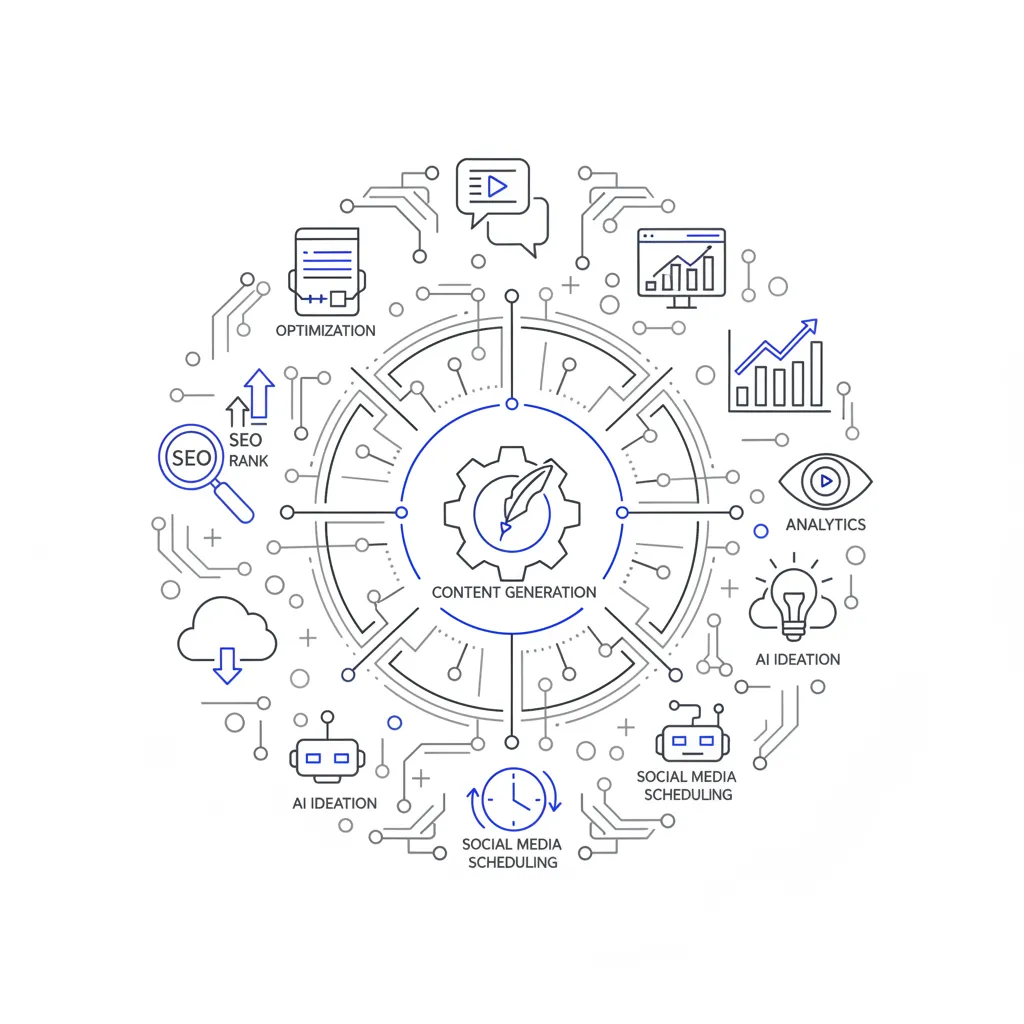
Modern platforms integrate multiple functions, from research and writing to optimization and distribution. This integration eliminates the need to manually transfer content between different tools, reducing errors and saving additional time.
| Tool | Best For | Starting Price | Key Feature |
|---|---|---|---|
| Semrush Content Toolkit | SEO-optimized content | $60/month | AI article generator |
| ChatGPT | Versatile writing tasks | $20/month | General-purpose AI |
| Grammarly | Error-free writing | $30/month | Advanced editing |
| AutoRanq | Autonomous content workflows | Custom pricing | Self-executing AI systems |
Each tool category serves different needs in your content workflow. Some excel at ideation and research, while others focus on writing quality or SEO optimization.
Semrush Content Toolkit
Semrush's Content Toolkit specializes in creating search-optimized content that ranks well from publication. The platform combines keyword research, competitive analysis, and AI writing in one integrated workflow.
The tool generates comprehensive content briefs based on top-ranking pages for your target keywords. It analyzes competitor content to identify gaps and opportunities, ensuring your articles cover topics that search engines reward.
Users report reducing article creation time from several hours to under 30 minutes while improving search rankings. The AI understands SEO requirements and naturally incorporates optimization elements without keyword stuffing.
Pricing starts at $60 monthly, with additional SEO-optimized articles available for $30 per 10-article pack. This represents significant cost savings compared to hiring freelance writers or agencies for similar output.
ChatGPT for Content Generation
ChatGPT offers the most versatile AI writing capabilities for content teams. Its strength lies in adapting to different content types, from blog posts and social media updates to email campaigns and product descriptions.
The platform excels at maintaining brand voice consistency across different content formats. You can train it on your existing content to replicate your tone and messaging style automatically.
Advanced users leverage ChatGPT for content ideation, outline creation, and first-draft generation. The tool handles research synthesis, turning multiple sources into coherent, original content that serves your specific audience needs.
With plans starting at $20 monthly for Plus and scaling to enterprise solutions, ChatGPT provides accessible AI writing capabilities for teams of any size.
Grammarly for Error-Free Writing
Grammarly transforms the editing process from time-consuming manual review to instant, AI-powered quality assurance. The platform catches errors that human editors often miss while maintaining natural writing flow.
Beyond basic grammar checking, Grammarly analyzes tone, clarity, and engagement levels. It suggests improvements that make content more persuasive and easier to read, directly impacting conversion rates.
The business version integrates with content management systems and collaboration tools, enabling real-time editing across your entire content workflow. Team features ensure consistent quality standards regardless of who creates the initial content.
Professional plans start at $30 per user monthly, with enterprise options providing advanced analytics and team management features for larger organizations.
3. Implementing AI-Driven Content Strategies
Successful automation requires strategic implementation that aligns with your marketing objectives and team capabilities. The key is starting with clear processes before adding technological complexity.

Begin by mapping your current content workflow to identify bottlenecks and repetitive tasks. These pain points represent the best opportunities for automation that will deliver immediate value to your team. For many an SMB, this transition is the difference between stagnation and rapid growth.
Integration timing matters significantly. Implementing too many tools simultaneously can overwhelm your team and reduce adoption rates. Roll out automation gradually, allowing team members to master each tool before adding new capabilities.
Training and change management determine automation success more than tool selection. Invest in comprehensive training that helps team members understand how automation enhances rather than replaces their creative contributions.
Creating a Content Calendar with AI
AI-powered content calendars go beyond simple scheduling to provide intelligent recommendations based on search trends, seasonal patterns, and audience behavior data.
These systems analyze your industry landscape to identify optimal publishing times, trending topics, and content gaps that represent opportunities for increased visibility and engagement.
Smart calendars automatically adjust recommendations based on performance data. If certain content types consistently outperform others, the system prioritizes similar content in future planning cycles.
Integration with social media platforms and email marketing tools ensures consistent messaging across all channels while adapting content format and tone for each platform's unique requirements.
Real-Time Optimization Techniques
Modern content optimization happens continuously rather than as a one-time activity. AI tools monitor search algorithm changes, competitor updates, and performance metrics to recommend ongoing improvements.
Real-time systems track keyword rankings, click-through rates, and user engagement signals to identify optimization opportunities as they emerge. This proactive approach prevents ranking declines and capitalizes on trending topics.
Leading content teams use automated monitoring to update existing content when competitors publish stronger pieces or when search intent shifts require different approaches.
The result is content that maintains and improves its search performance over time rather than gradually declining as newer content enters the market.
4. Measuring Success and ROI
Automated content creation success requires different metrics than traditional manual processes. You need to track both efficiency gains and quality improvements to understand true ROI.
Traditional metrics like time-to-publish remain important, but automation enables new performance indicators that better reflect business impact. Focus on metrics that connect content performance to revenue generation and customer acquisition.
Quality metrics become more sophisticated with automation. Instead of subjective editorial review, you can track semantic relevance scores, readability indices, and SEO optimization levels automatically.
Revenue attribution improves when automated systems track content performance from initial publication through conversion. This end-to-end visibility reveals which content types and topics drive the highest business value.
Tools for Tracking Performance
Modern analytics platforms integrate with content automation tools to provide comprehensive performance insights without manual data compilation.
Google Analytics 4 offers enhanced content performance tracking that connects page views to business outcomes. Custom events track how automated content performs compared to manually created pieces across key conversion metrics.
SEO platforms like Ahrefs and SEMrush provide automated ranking monitoring that alerts you to significant changes in search visibility. These tools track hundreds of keywords simultaneously, identifying trends that manual monitoring would miss.
Content management systems increasingly include built-in analytics that show which automated content performs best, helping you refine your automation strategies for maximum impact.
Adjusting Strategies Based on Data
Data-driven optimization requires systematic analysis of automation performance across different content types, topics, and distribution channels.
Successful teams establish regular review cycles that examine automation effectiveness and identify opportunities for improvement. Monthly analysis reveals patterns that daily monitoring might miss.
A/B testing becomes more sophisticated with automation. You can test different AI prompts, content structures, and optimization approaches simultaneously to identify the most effective combinations.
Feedback loops between performance data and automation settings enable continuous improvement. When certain content types consistently outperform others, you can adjust automation parameters to prioritize successful approaches.
AutoRanq: The Future of Autonomous Content Creation
AutoRanq represents the next evolution in content automation, moving beyond simple task automation to autonomous content strategies that think, plan, and execute complex workflows independently.
The platform's autonomous AI systems explore topic landscapes automatically, identifying content gaps and emerging search trends through recursive exploration. This proactive approach keeps your content strategy ahead of market changes.
Unlike traditional tools that require constant human input, AutoRanq's AI agents work continuously in the background, generating outlines, identifying opportunities, and optimizing content in real-time based on performance data.
The system's unique value lies in its ability to execute complex content strategies with minimal human intervention. While other tools automate individual tasks, AutoRanq automates entire strategic workflows.
Marketing teams using AutoRanq report significant improvements in content velocity and search performance while reducing the manual effort required to maintain competitive content strategies.
Advanced Automation Strategies
Sophisticated content automation goes beyond individual tool implementation to create integrated systems that handle end-to-end content workflows automatically.
Multi-tool integration enables seamless data flow between research, creation, optimization, and distribution phases. Content moves through the entire workflow without manual handoffs that introduce delays and errors.
Workflow automation platforms like Zapier connect different content tools, triggering actions based on specific conditions. For example, when a new keyword opportunity is identified, the system automatically generates a content brief and assigns it to the appropriate team member.
Advanced teams implement content personalization at scale, using AI to adapt base content for different audience segments, geographic markets, or customer journey stages automatically.
Building Scalable Content Systems
Scalable automation requires standardized processes that work consistently regardless of content volume or team size. Documentation and training ensure that automation benefits persist as your team grows.
Template systems accelerate content creation while maintaining quality standards. AI-powered templates adapt to different topics and industries while preserving your brand voice and messaging consistency.
Quality control mechanisms prevent automation from producing off-brand or low-quality content. Automated review systems flag content that doesn't meet predefined standards before publication.
Version control and collaboration features ensure that multiple team members can work with automated content simultaneously without conflicts or duplication of effort.
Integration with Existing Marketing Stack
Successful automation integrates seamlessly with your existing marketing technology stack rather than requiring wholesale system changes.
CRM integration enables content automation based on customer data and behavior patterns. Automated systems can generate personalized content for specific customer segments or individual prospects automatically.
Marketing automation platforms benefit from AI-generated content that adapts to different campaign requirements and audience preferences without manual customization.
Social media management tools integrate with content automation to ensure consistent messaging across all channels while adapting format and tone for platform-specific requirements.
Overcoming Common Automation Challenges
Content automation implementation faces predictable challenges that successful teams address proactively through planning and change management.
Quality concerns represent the most common objection to automation. Address these by implementing robust review processes and gradually increasing automation scope as team confidence grows.
Brand voice consistency requires careful AI training and regular monitoring. Develop clear brand guidelines and use them to train automation tools on your specific tone and messaging requirements.
Team resistance often stems from fear that automation will replace human creativity. Frame automation as a creative amplifier that handles routine tasks so team members can focus on strategy and innovation.
Maintaining Human Oversight
Effective automation maintains human oversight at critical decision points while automating routine execution tasks.
Editorial review processes ensure that automated content meets quality standards and aligns with current marketing objectives before publication.
Strategic direction remains a human responsibility. AI handles tactical execution, but humans define goals, target audiences, and overall content strategy.
Performance monitoring requires human interpretation of data trends and strategic adjustments based on changing market conditions or business priorities.
Ensuring Content Authenticity
Automated content must maintain authenticity and provide genuine value to your audience. This requires careful prompt engineering and quality control processes.
Fact-checking procedures verify that automated content includes accurate information and properly cites authoritative sources when making claims or presenting data.
Originality checks prevent duplicate content issues that could harm search rankings. Automated systems should generate unique content rather than simply rewriting existing material.
Voice and tone consistency ensures that automated content feels authentic to your brand while adapting appropriately for different content types and audience segments.
Future Trends in Content Automation
Content automation technology continues evolving rapidly, with new capabilities emerging that will further transform how marketing teams create and optimize content.
Multimodal AI systems will soon generate coordinated content across text, images, video, and audio formats simultaneously. This integrated approach will enable more engaging content experiences with less manual coordination.
Predictive content systems will anticipate trending topics and search intent changes before they become obvious to competitors. Early adoption of emerging trends provides significant competitive advantages.
Real-time personalization will enable content that adapts automatically to individual user preferences and behavior patterns, creating unique experiences for each visitor.
Emerging Technologies
Voice AI integration will enable content creation through natural conversation rather than complex prompt engineering. Teams will be able to describe their content needs conversationally and receive publication-ready results.
Blockchain verification systems may provide content authenticity tracking that builds trust with both search engines and human audiences in an era of increasing AI-generated content.
Augmented reality content creation will enable automated generation of immersive experiences that blend digital content with real-world environments.
Advanced analytics will provide deeper insights into content performance, enabling more sophisticated optimization strategies that consider factors beyond traditional SEO metrics.
Building Your Automation Strategy
Developing an effective content automation strategy requires careful planning that aligns technology capabilities with business objectives and team resources.
Start with a comprehensive audit of your current content processes to identify the highest-impact automation opportunities. Focus on areas where automation will provide immediate value while building foundation for future expansion.
Pilot programs allow you to test automation tools and approaches on a small scale before committing to organization-wide implementation. This reduces risk while providing valuable learning opportunities.
Change management planning ensures that team members understand how automation will enhance their roles rather than replace them. Communication and training are critical success factors.
Budget allocation should account for both tool costs and implementation time. Factor in training, integration, and optimization efforts when calculating total automation investment.
Conclusion
The alternative to manual content creation lies in strategic automation that amplifies human creativity while handling repetitive tasks automatically. Modern AI-powered platforms provide sophisticated solutions that maintain quality while dramatically increasing output and efficiency.
Key takeaways for implementing content automation:
- Automated tools can increase content production by 300% while improving SEO performance and consistency
- Integration with existing workflows prevents disruption while maximizing automation benefits
- Quality control processes ensure that automated content meets brand standards and provides genuine value
- Performance measurement requires new metrics that connect content efficiency to business outcomes
- Strategic implementation with proper training and change management determines automation success
- Future automation capabilities will provide even more sophisticated content creation and optimization options
The shift from manual to automated content creation represents more than a technological upgrade—it's a strategic transformation that enables marketing teams to focus on high-value activities while maintaining competitive content production.
Companies that embrace automation now will build significant competitive advantages as content velocity and optimization accuracy become increasingly important for market success. For any freelancer or agency owner, this shift is essential for scaling operations.
Ready to transform your content creation process? Explore how AutoRanq's autonomous AI systems can automate your entire content workflow, from strategy development to performance optimization, freeing your team to focus on innovation and growth.