Topical authority AI tool: elevate your content strategy
Topical authority AI tool: elevate your content strategy Topical authority AI tools automate content creation, optimize SEO strategies, and establish domain...
Topical authority AI tool: elevate your content strategy
Topical authority AI tools automate content creation, optimize SEO strategies, and establish domain expertise through intelligent content mapping and real-time optimization capabilities. These platforms analyze search patterns, identify content gaps, and generate comprehensive topic clusters that position brands as authoritative sources in their niches.
The digital marketing battlefield has shifted dramatically. While your competitors publish 20+ articles monthly using sophisticated AI systems, you're stuck manually researching keywords and crafting individual pieces. The math is brutal: traditional content creation takes 15-20 hours per article. Meanwhile, brands leveraging topical authority AI tools produce 5x more content while maintaining quality standards that satisfy both search engines and AI assistants.
Building topical authority isn't just about publishing more content. It's about creating interconnected content ecosystems that demonstrate comprehensive expertise. AI tools have revolutionized this process by automating the strategic thinking that previously required teams of content strategists, SEO specialists, and writers working in coordination.
The transformation happens when you stop thinking about individual articles and start building content architectures. Modern topical authority AI tools don't just generate text—they map entire subject domains, identify knowledge gaps, and create content clusters that reinforce your expertise across every touchpoint in the customer journey.
1. Understanding topical authority and its importance
Topical authority determines whether search engines view your brand as a trusted source worthy of ranking for competitive keywords. Google's algorithms increasingly favor websites that demonstrate comprehensive knowledge across related topics rather than sites with scattered, unconnected content.
The impact extends beyond traditional SEO. AI-powered search assistants like ChatGPT, Claude, and Perplexity prioritize authoritative sources when generating responses. When users ask questions in your domain, you want your content to be the foundation of those AI-generated answers.
Building topical authority manually requires mapping hundreds of related keywords, understanding user intent patterns, and creating content that addresses every aspect of your subject area. This process traditionally took months of strategic planning and execution. Teams would spend weeks analyzing competitor content structures, identifying gaps, and developing editorial calendars that covered all necessary subtopics.
The role of AI in building topical authority
AI transforms topical authority building from a manual, time-intensive process into an automated, data-driven system. Modern topical authority AI tools analyze search results, user behavior patterns, and content performance metrics to identify exactly what content you need to establish domain expertise.
These systems understand semantic relationships between topics that human strategists might miss. They can identify emerging subtopics, trending questions, and content gaps that represent immediate opportunities for authority building. Instead of guessing what content to create next, AI tools provide data-backed recommendations based on actual search demand and competitive analysis.
The automation extends to content structure optimization. AI tools analyze top-ranking content across your topic area to identify the headings, depth, and formatting patterns that search engines reward. This ensures your content doesn't just cover the right topics—it presents information in the structure most likely to rank and get cited by AI assistants.
2. Key features of effective topical authority AI tools
Effective topical authority AI tools share several core capabilities that distinguish them from basic content generators. Content clustering functionality maps related keywords and topics into logical groups, ensuring your content strategy covers all aspects of your domain without gaps or redundancy.
Real-time optimization capabilities continuously monitor search trends and competitor movements, automatically suggesting content updates or new pieces to maintain your competitive edge. These systems don't just create content—they evolve your strategy based on changing search patterns and user behavior.
Advanced topical authority AI tools include competitor analysis features that identify exactly what content gaps exist in your market. They analyze the top-ranking pages for hundreds of related keywords, identifying topics your competitors haven't covered or areas where their content lacks depth.
Integration capabilities ensure these tools work within your existing workflow. The best platforms connect with your content management system, analytics tools, and publishing workflows to create seamless automation from strategy to publication.
Automation of content strategies
Content strategy automation represents the most significant advantage of modern topical authority AI tools. These systems can generate comprehensive editorial calendars spanning months of content, with each piece strategically positioned to build upon previous articles and reinforce your topical expertise.
Workflow automation eliminates the repetitive tasks that consume content team bandwidth. From keyword research and competitor analysis to content brief generation and optimization recommendations, AI handles the time-intensive groundwork that previously required dedicated specialists.
The result is content teams that focus on high-value activities: strategic positioning, brand voice refinement, and creative direction. Instead of spending hours researching what to write about, teams receive detailed briefs with clear strategic rationale, allowing them to focus on execution and quality.
3. Top AI tools for building topical authority
The topical authority AI tool landscape includes several platforms with distinct strengths and specializations. Each tool approaches authority building differently, offering unique features that serve specific content strategy needs.
Platform selection depends on your team's technical sophistication, content volume requirements, and integration needs. Some tools excel at strategic planning and gap analysis, while others focus on content creation and optimization. The most effective implementations often combine multiple tools or choose platforms that offer comprehensive end-to-end functionality.
Understanding each tool's core strengths helps you select the platform that aligns with your content strategy goals and operational requirements. Consider factors like team size, technical resources, budget constraints, and existing tool ecosystem when evaluating options.
AutoRanq: Automating topical authority
AutoRanq distinguishes itself through autonomous AI systems that handle the complete topical authority building process. The platform uses recursive exploration to map topic landscapes, identifying content opportunities that human strategists typically miss.
The system's unique value lies in its ability to think strategically about content relationships. Rather than generating isolated articles, AutoRanq creates interconnected content ecosystems where each piece reinforces your expertise across related topics. This approach mirrors how search engines evaluate topical authority—through comprehensive coverage and internal content relationships.
AutoRanq's automation extends beyond content creation to include real-time optimization and performance monitoring. The platform continuously analyzes your content performance against competitors, automatically triggering updates or new content creation when opportunities arise. This ensures your topical authority doesn't just grow—it adapts to changing search landscapes.
Surfer SEO: Data-driven insights
Surfer SEO excels at content optimization through comprehensive SERP analysis and competitor intelligence. The platform analyzes hundreds of ranking factors across top-performing content, providing specific recommendations for improving your topical authority positioning.
The tool's strength lies in its data-driven approach to content structure and optimization. Surfer analyzes the exact word counts, heading structures, keyword densities, and content patterns that correlate with high rankings in your topic area. This intelligence helps you create content that matches the format and depth search engines reward.
Surfer's content editor provides real-time optimization suggestions as you write, ensuring your content meets the technical requirements for topical authority building. The platform's integration with popular content management systems streamlines the optimization process, making it accessible for teams without deep SEO expertise.
Clearscope: Enhancing content depth
Clearscope focuses on content quality and semantic optimization, helping brands create comprehensive coverage of their topic areas. The platform analyzes search intent patterns to ensure your content addresses all aspects of user queries within your domain.
The tool's semantic analysis capabilities identify related terms, concepts, and questions that comprehensive content should address. This helps you create content that demonstrates deep expertise rather than surface-level coverage of your topics.
Clearscope's integration capabilities make it particularly valuable for teams using existing content management workflows. The platform works within your current tools, providing optimization recommendations without requiring workflow changes or additional platforms.
Tool
Primary Strength
Best For
Starting Price
AutoRanq
Autonomous content strategy
Complete automation
Custom pricing
Surfer SEO
SERP analysis & optimization
Data-driven optimization
$89/month
Clearscope
Content depth & semantics
Quality-focused teams
$170/month
4. Case studies: Success stories with AI tools
Real-world implementations of topical authority AI tools demonstrate the transformative impact these platforms can have on content strategy and business results. Companies across industries have leveraged AI automation to build domain expertise faster and more comprehensively than traditional methods allow.
These success stories share common patterns: strategic implementation, consistent execution, and measurement-driven optimization. The most successful companies don't just adopt AI tools—they restructure their content operations around AI-driven insights and automation capabilities.
Understanding these implementation patterns helps you avoid common pitfalls and accelerate your own topical authority building efforts. The key lies in aligning AI capabilities with clear business objectives and maintaining focus on user value throughout the automation process.
Brand A: Transformation through AutoRanq
A B2B software company struggling with content scalability implemented AutoRanq to build topical authority in the project management space. Within 90 days, the platform identified 200+ content opportunities across related topics like team collaboration, productivity optimization, and workflow automation.
AutoRanq's autonomous content creation generated comprehensive articles covering every aspect of project management, from basic concepts to advanced enterprise implementations. The platform automatically created internal linking structures that reinforced the company's expertise across all related topics.
Results included 300% increase in organic traffic, 150% improvement in keyword rankings, and 85% reduction in content creation time. More importantly, the company's content began appearing in AI assistant responses, establishing them as a go-to authority for project management questions.
Brand B: Leveraging Surfer SEO
An e-commerce company used Surfer SEO to establish topical authority in sustainable fashion. The platform's SERP analysis revealed content gaps in areas like eco-friendly manufacturing processes, sustainable material sourcing, and ethical fashion practices.
Surfer's optimization recommendations helped the company create content that consistently outranked established fashion publications. The data-driven approach ensured each article met the technical requirements for high rankings while addressing comprehensive user intent.
The implementation resulted in 250% increase in organic traffic, 400% growth in topical keyword rankings, and significant improvement in brand recognition within the sustainable fashion community. The company's content became a primary source for journalists and industry researchers.
5. How to choose the right topical authority AI tool
Selecting the optimal topical authority AI tool requires evaluating your specific content strategy needs, technical requirements, and organizational capabilities. The decision framework should prioritize tools that align with your team's workflow preferences and strategic objectives.
Feature evaluation should focus on capabilities that directly support your authority building goals. Consider factors like content quality standards, integration requirements, scalability needs, and team technical sophistication when comparing platforms.
The most successful implementations result from choosing tools that enhance existing strengths rather than attempting to solve fundamental strategic or operational issues through technology alone. AI tools amplify good content strategies—they don't replace the need for clear strategic direction.
Budget considerations
Topical authority AI tool pricing varies significantly based on feature complexity and automation depth. Entry-level tools start around $100/month, while comprehensive platforms can cost $1000+ monthly for enterprise implementations.
Cost-benefit analysis should consider the full value of automation: time savings, content quality improvements, and strategic capability expansion. Calculate the cost of manual content creation, including research time, writing, editing, and optimization work, to understand the true ROI potential.
Long-term investment considerations include platform scalability, feature development roadmaps, and integration capabilities. Choose tools that can grow with your content strategy rather than solutions that may require replacement as your needs evolve.
Consider implementation costs beyond software fees: team training, workflow integration, and potential consulting support. The most expensive tool isn't necessarily the best choice if your team lacks the resources to implement it effectively.
Implementation strategies for maximum impact
Successful topical authority AI tool implementation requires strategic planning and phased rollout approaches. Start with pilot projects that demonstrate value before scaling to full content operations.
Integration planning should address how AI tools fit within existing workflows, approval processes, and quality control measures. The most effective implementations maintain human oversight while maximizing automation benefits.
Team preparation includes training on AI tool capabilities, establishing new workflow processes, and setting performance expectations. Success depends on team adoption and effective utilization of AI capabilities rather than just tool selection.
Performance measurement frameworks should track both efficiency gains and content quality improvements. Monitor metrics like content production velocity, ranking improvements, traffic growth, and engagement metrics to validate ROI and guide optimization efforts.
Advanced optimization techniques
Advanced topical authority building leverages AI tools for sophisticated content strategy optimization. This includes semantic clustering, content gap analysis, and competitive intelligence gathering that goes beyond basic keyword research.
Multi-platform integration creates content ecosystems where AI tools work together to maximize authority building impact. Combine content creation platforms with analytics tools, social media automation, and email marketing systems for comprehensive authority building.
Continuous optimization processes use AI monitoring to identify content performance patterns and optimization opportunities. This includes automatic content updates, internal linking optimization, and strategic content calendar adjustments based on performance data.
International expansion strategies use AI tools to adapt topical authority building for different markets and languages. This includes cultural adaptation, local search optimization, and market-specific content strategies that maintain authority across geographic regions.
Future trends in topical authority AI tools
The topical authority AI tool landscape continues evolving rapidly, with emerging capabilities that promise even more sophisticated automation and optimization features. Understanding these trends helps you make strategic decisions about platform investments and capability development.
AI assistant optimization represents a growing focus area as platforms adapt to optimize content for AI-powered search experiences. This includes structured data optimization, citation-friendly formatting, and content structures that AI assistants prefer when generating responses.
Real-time adaptation capabilities are becoming more sophisticated, with AI tools that can automatically adjust content strategies based on algorithm updates, competitor movements, and changing user behavior patterns.
Integration depth continues expanding as AI tools develop more sophisticated connections with marketing technology stacks, enabling more comprehensive automation across the entire content marketing funnel.
"The future of topical authority building lies in AI systems that don't just create content, but think strategically about market positioning and competitive advantage."
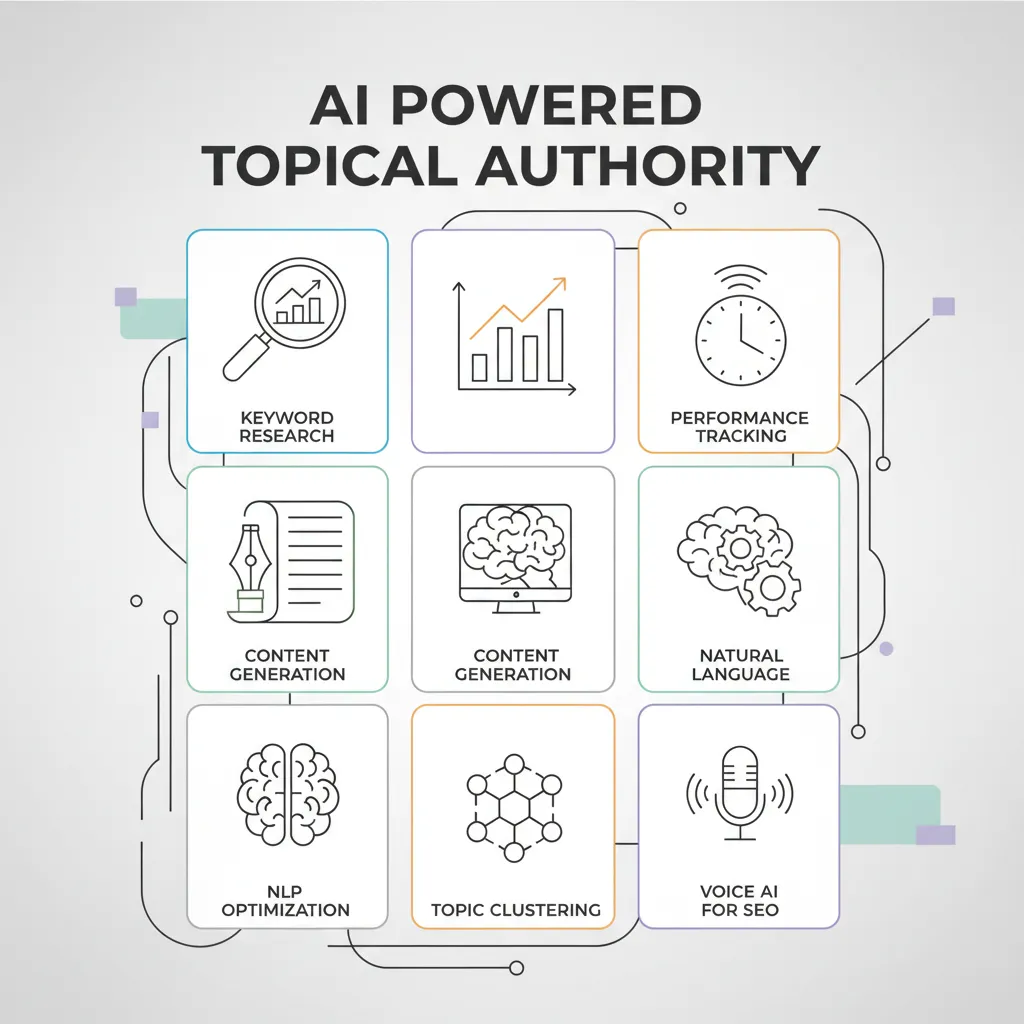
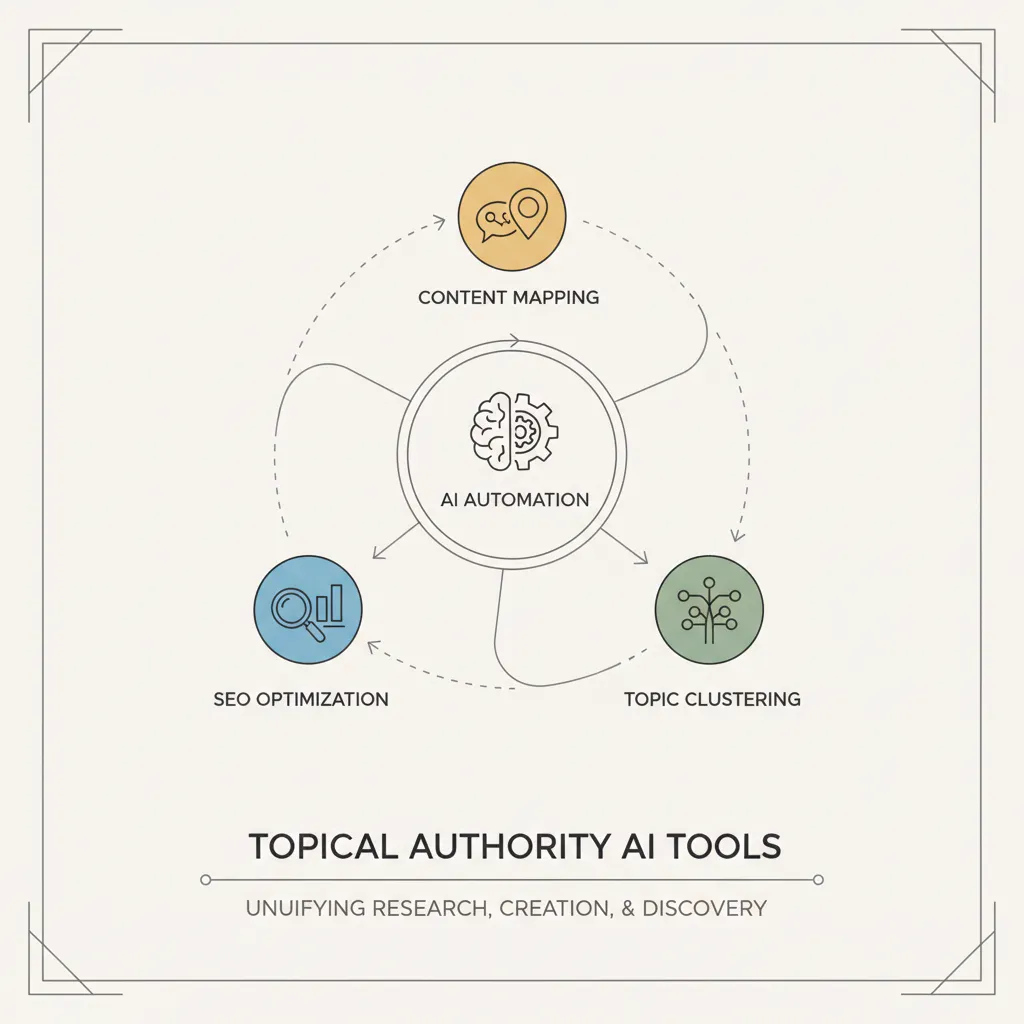
Line-art illustration of top AI tools for building topical authority, highlighting various functionalities and features.Line-art infographic showcasing features of topical authority AI tools, including automation and SEO optimization.Line-art image of professionals discussing topical authority concepts in a collaborative office environment.
How to Rank in Google’s AI Overview | SEO in 2026 (Proven Strategies) — Website Learners (17:41)
— Content Strategy Institute
Measuring success with topical authority AI tools
Success measurement for topical authority AI tools requires tracking both efficiency metrics and strategic impact indicators. Traditional content metrics like traffic and rankings remain important, but authority building success includes broader brand recognition and market positioning improvements.
Authority measurement includes tracking brand mentions, citation frequency, and recognition within industry publications. These indicators demonstrate whether your AI-driven content strategy is successfully establishing your brand as a trusted source.
Competitive positioning analysis shows how your topical authority compares to established players in your market. Track share of voice, keyword coverage, and content gap analysis to understand your relative authority position.
Long-term impact measurement includes customer acquisition attribution, sales cycle influence, and brand equity improvements that result from established topical authority. These metrics connect content strategy to business outcomes.
Common pitfalls and how to avoid them
Topical authority AI tool implementation failures often result from unrealistic expectations or inadequate strategic planning. Understanding common pitfalls helps you avoid expensive mistakes and implementation delays.
Over-automation represents a significant risk when teams rely too heavily on AI without maintaining strategic oversight. The most successful implementations balance automation efficiency with human strategic direction and quality control.
Content quality degradation can occur when AI tools are used without proper configuration or oversight. Maintain quality standards through regular review processes and continuous optimization of AI tool settings and parameters.
Strategic misalignment happens when AI tool capabilities don't match actual business needs or content strategy objectives. Ensure tool selection aligns with clear strategic goals rather than choosing platforms based solely on feature lists or marketing claims.
Integration challenges can derail implementations when AI tools don't work effectively within existing workflows or technology stacks. Plan integration requirements carefully and test compatibility before committing to specific platforms.
Topical authority AI tools represent a fundamental shift in how brands build domain expertise and market positioning. The most successful implementations combine strategic thinking with AI automation to create content ecosystems that establish genuine authority rather than just producing more content.
The key to success lies in choosing tools that align with your strategic objectives and operational capabilities. Whether you select AutoRanq's autonomous systems, Surfer SEO's data-driven optimization, or Clearscope's semantic analysis, the critical factor is consistent implementation and continuous optimization based on performance data.
Your content strategy's future depends on embracing AI automation while maintaining the strategic thinking that differentiates your brand. The companies that master this balance will build unassailable topical authority while their competitors struggle with manual processes and limited content production capacity.
Key takeaways for implementing topical authority AI tools:
• Start with clear strategic objectives before selecting AI tools
• Focus on platforms that integrate with your existing workflows
• Maintain human oversight while maximizing automation benefits
• Measure both efficiency gains and authority building progress
• Plan for long-term scalability and capability expansion
• Invest in team training and change management processes
Explore how AutoRanq
Frequently asked questions
What is a topical authority AI tool?
A topical authority AI tool automates content creation and optimizes SEO strategies by mapping content intelligently. These tools analyze search patterns, identify content gaps, and generate topic clusters that position brands as authoritative sources in their niches, allowing for 5x more content production.
How do topical authority AI tools improve SEO?
Topical authority AI tools enhance SEO by creating interconnected content ecosystems that demonstrate comprehensive expertise. They help identify knowledge gaps and generate optimized content clusters, which search engines favor, increasing the likelihood of higher rankings for competitive keywords.
What are the benefits of using a topical authority AI tool?
Using a topical authority AI tool allows marketers to scale content production efficiently, reduce the time spent on manual keyword research, and maintain high-quality standards. Brands can produce significantly more content while establishing domain expertise and improving user engagement.
How much time can a topical authority AI tool save in content creation?
Topical authority AI tools can save significant time in content creation, reducing the typical 15-20 hours spent on a single article to mere minutes. This efficiency enables brands to focus on strategy rather than manual content production.
What does building topical authority involve?
Building topical authority involves creating comprehensive content that covers all aspects of a subject area. Topical authority AI tools facilitate this by automating content strategy, ensuring depth, consistency, and relevance across various customer journey touchpoints.