
Understanding conversational AI search intent for marketers
Understanding Conversational AI Search Intent for Marketers Conversational AI search intent represents the shift from traditional keyword-based queries to...
Understanding Conversational AI Search Intent for Marketers
Conversational AI search intent represents the shift from traditional keyword-based queries to natural dialogue interactions where AI systems understand user needs through context, follow-up questions, and multi-turn conversations. This transformation fundamentally changes how marketers must approach content optimization and user engagement strategies. To stay ahead, many companies are now looking to automate optimization workflows to keep pace with these rapid algorithmic shifts.
Conversational AI is reshaping how users interact with search engines, moving beyond traditional keyword queries to dynamic dialogues that reflect real human interactions. This shift affects user experience and has significant implications for marketers aiming to optimize their content strategies for AI-driven platforms.
The rise of conversational AI search intent marks a fundamental departure from the keyword-centric approach that dominated SEO for decades. Users now engage with search systems through natural language, asking complex questions and expecting nuanced, contextual answers that address their specific needs and circumstances.
The Evolution of Search Behavior with Conversational AI
Search behavior has transformed dramatically as users embrace conversational interfaces. Instead of typing fragmented keywords like "best CRM software," users now ask complete questions: "What CRM software works best for a 50-person SaaS company with remote teams?"

This shift from keyword-based to conversational queries represents more than a technological upgrade. It reflects how people naturally think and communicate. Sight AI research shows that generative AI usage for content discovery increased 156% year-over-year as users became comfortable with detailed, conversational prompts.
The impact on user engagement extends beyond query format. Conversational AI search intent enables multi-turn interactions where users refine their questions based on initial responses. A marketing manager might start with "How do I improve our content strategy?" then follow up with "What specific metrics should I track?" and "Which tools integrate with our existing marketing stack?"
Search results now prioritize content that anticipates these conversation flows. Pages that answer isolated questions perform poorly compared to comprehensive resources that address entire user journeys. This change forces marketers to think beyond individual keywords and consider complete conversation pathways. Utilizing an autonomous AI system can help identify these evolving question patterns before competitors do.
How Conversational AI Understands User Intent
Natural language processing capabilities enable AI systems to interpret context, tone, and implied meaning in user queries. Unlike traditional search engines that matched keywords to content, conversational AI analyzes semantic relationships and user context to deliver relevant responses.
Contextual understanding of multi-turn interactions allows AI to maintain conversation history and provide increasingly refined answers. When a user asks follow-up questions, the AI considers previous exchanges to deliver more precise and helpful responses. This capability transforms search from a series of isolated queries into coherent dialogues.
Modern AI systems recognize implicit intent signals within conversational queries. A question like "Is this worth the investment?" requires the AI to understand what "this" refers to based on conversation context. This sophisticated interpretation demands content that provides clear, contextual information AI can confidently extract and cite.
Economic Implications of Conversational AI in Search
The economic landscape shifts significantly as businesses adapt to conversational AI search intent. Cost-effectiveness emerges as a primary driver for companies adopting AI strategies, with many organizations reporting substantial efficiency gains from automated content optimization and customer engagement processes.

Increased competition for visibility in AI-generated results creates new challenges for marketers. Traditional SEO tactics become less effective as AI systems prioritize authoritative, comprehensive content over keyword-optimized pages. Companies must invest in creating substantive resources that AI systems trust enough to cite in their responses. For an SMB, the ability to identify content opportunities automatically is becoming a critical survival tactic in this competitive space.
The shift toward conversational AI search intent also democratizes access to information. Smaller businesses can compete with larger enterprises by creating highly relevant, contextual content that addresses specific user needs. This levels the playing field for companies willing to invest in understanding and optimizing for conversational search patterns.
Revenue implications extend beyond direct search traffic. Businesses that successfully optimize for conversational AI search intent often see improved customer satisfaction, reduced support costs, and higher conversion rates as users find more relevant information more quickly.
Case Studies of Successful Implementation
Several businesses have successfully leveraged conversational AI to improve their search visibility and customer engagement. SaaS companies particularly benefit from this approach because their target audiences often have complex, multi-faceted questions about software capabilities and implementation.
One notable example involves a project management software company that restructured their content around conversational intent mapping. Instead of separate pages for "project management features" and "team collaboration tools," they created comprehensive guides addressing complete user journeys like "How to choose project management software for distributed teams."
The strategies that led to improved search visibility included creating content clusters that address entire conversation flows, implementing structured data to help AI systems extract relevant information, and developing FAQ sections that anticipate follow-up questions users might ask during their research process.
Optimizing Content for Conversational AI Search Intent
Creating content that answers specific user questions requires a fundamental shift in content strategy. Rather than targeting individual keywords, successful content addresses complete user journeys and anticipates the natural progression of questions users ask when exploring a topic.
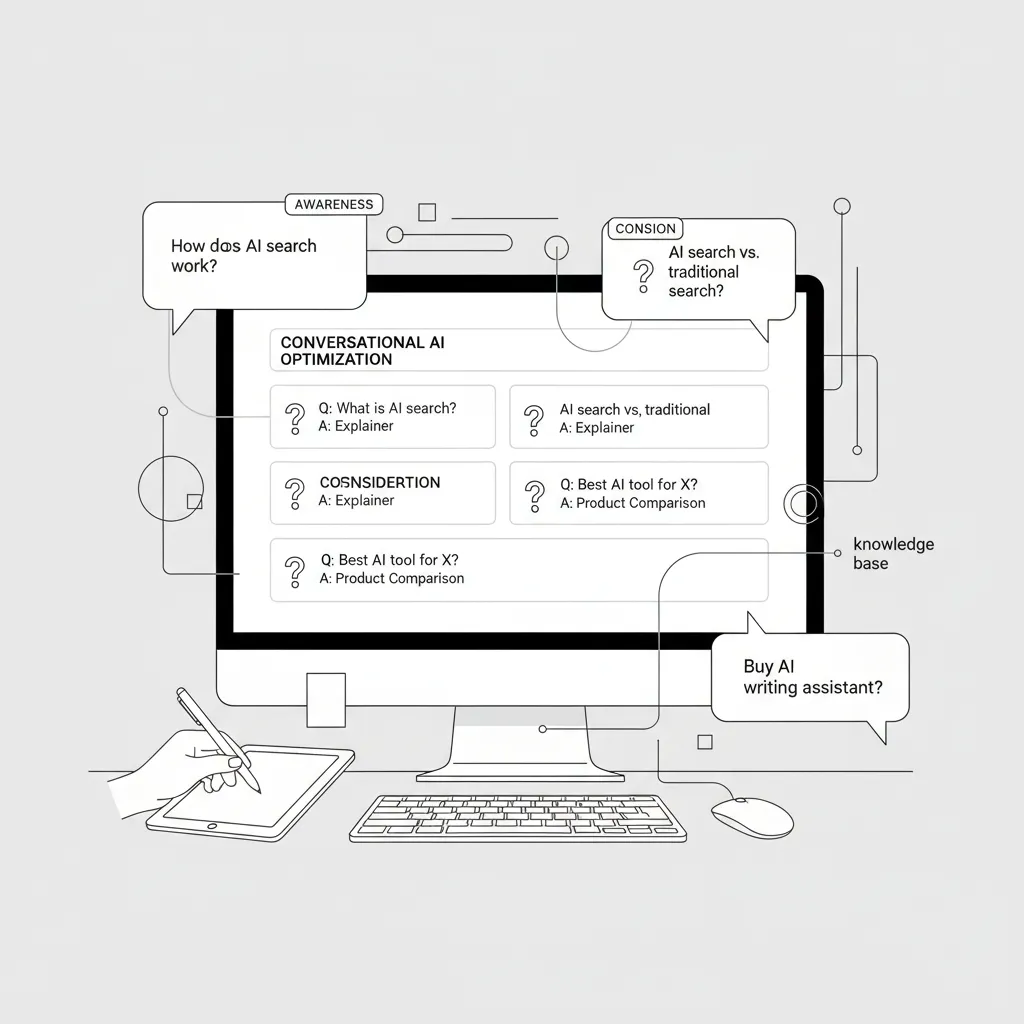
Structuring information for AI extraction becomes critical as AI systems need to identify and cite relevant passages confidently. This means organizing content with clear hierarchies, using descriptive headings, and providing definitive answers that AI can extract without ambiguity.
Content optimization for conversational AI search intent also requires understanding how users naturally progress through topics. A marketing professional researching "conversational AI search intent" might start with basic definitions, progress to implementation strategies, and conclude with specific tools and metrics for measurement. To scale this effort, many teams use AutoRanq to manage the high volume of updates required for topic clusters.
The most effective content anticipates these progression patterns and provides comprehensive coverage that satisfies users at every stage of their inquiry. This approach not only improves AI citation rates but also enhances user experience by reducing the need for multiple searches.
| Traditional Search Strategy | Conversational AI Strategy |
|---|---|
| Target individual keywords | Address complete conversation flows |
| Optimize for search rankings | Optimize for AI citations |
| Create keyword-focused pages | Develop comprehensive topic clusters |
| Measure success through rankings | Track AI visibility and citations |
| Focus on click-through rates | Prioritize answer accuracy and completeness |
Techniques for Effective Conversational Content
Utilizing conversational intent mapping involves identifying the sequence of questions users typically ask about a topic and organizing content to address these questions in logical order. This technique ensures that content flows naturally and provides comprehensive coverage of user needs.
Incorporating FAQs and structured data helps AI systems identify relevant information more easily. Well-structured FAQ sections that address common follow-up questions significantly improve the likelihood of AI citation. Structured data markup provides additional context that helps AI systems understand content relationships and extract accurate information.
Successful conversational content also employs natural language patterns that mirror how users actually speak and think. This includes using complete sentences, addressing users directly, and providing context that helps both humans and AI systems understand the relevance and applicability of the information presented.
Future Trends in Conversational AI Search
Predictions for AI's role in shaping search behavior indicate continued growth in conversational interfaces and more sophisticated understanding of user intent. Similarweb research suggests that AI systems will become increasingly adept at interpreting complex, multi-faceted queries that require deep contextual understanding.
Emerging technologies promise even more sophisticated conversational AI capabilities. Advanced natural language processing, improved context retention across longer conversations, and better integration with various data sources will enable AI systems to provide more accurate and comprehensive responses to user queries.
The integration of conversational AI search intent with voice search, visual search, and other emerging interfaces will create new opportunities and challenges for marketers. Content strategies must evolve to accommodate these diverse interaction methods while maintaining consistency and effectiveness across all platforms.
Machine learning advances will enable AI systems to better understand user context, preferences, and intent over time. This evolution will require marketers to create more personalized, contextually relevant content that adapts to individual user needs and circumstances.
Preparing for the Next Generation of Search
Adapting strategies to evolving AI capabilities requires continuous learning and experimentation. Marketers must stay informed about AI developments, test new optimization techniques, and monitor how their content performs across different AI platforms and search interfaces.
The importance of continuous optimization cannot be overstated in the rapidly evolving landscape of conversational AI search intent. What works today may become less effective as AI systems become more sophisticated and user expectations continue to rise.
Successful preparation also involves investing in tools and platforms that can help monitor and optimize content for AI visibility. Platforms like Geol.ai provide comprehensive GEO (Generative Engine Optimization) capabilities that help businesses maximize visibility across AI-powered search engines and chatbots.
Measuring Success in Conversational AI Search
Traditional metrics like keyword rankings become less relevant when optimizing for conversational AI search intent. Instead, marketers must focus on AI citation rates, answer accuracy, and user satisfaction metrics that reflect how well content serves conversational queries. Modern content strategy now demands a focus on how often your brand is the primary source for an AI's synthesized answer.
Tracking AI visibility requires new tools and methodologies. Monitoring how often AI systems cite your content, analyzing the context of these citations, and measuring user engagement with AI-generated responses provide better insights into content performance in the conversational AI landscape.
Success measurement also involves understanding user behavior patterns within conversational interfaces. How do users progress through conversation flows? Where do they typically end their searches? What follow-up questions do they ask? These insights inform content optimization strategies and help predict future user needs.
Conversion tracking becomes more complex but potentially more valuable in conversational AI environments. Users who find comprehensive, helpful information through AI-mediated searches often demonstrate higher intent and better conversion rates than those who navigate through traditional search results.
Implementation Strategies for SaaS Companies
SaaS companies face unique challenges and opportunities when optimizing for conversational AI search intent. Their target audiences often have complex, technical questions that require detailed, contextual answers. This complexity makes conversational AI optimization particularly valuable for SaaS marketing strategies.
Product documentation, feature explanations, and implementation guides must evolve to address conversational query patterns. Instead of technical specifications lists, SaaS companies need comprehensive resources that address questions like "How does this feature solve my specific business problem?" and "What's the implementation timeline for a company like mine?"
Customer support integration with conversational AI search intent creates opportunities for improved user experience and reduced support costs. When potential customers can find detailed, accurate answers to their questions through AI-mediated searches, they arrive at sales conversations better informed and more qualified.
Competitive differentiation through conversational AI optimization becomes increasingly important as more SaaS companies recognize the value of this approach. Early adopters gain significant advantages by establishing authority in AI-generated responses and building trust with users who rely on conversational search interfaces.
Content Architecture for Conversational Search
Designing content architecture for conversational AI search intent requires thinking beyond traditional page structures. Content must be organized to support natural conversation flows while providing comprehensive coverage of related topics and questions.
Hierarchical information organization helps AI systems understand content relationships and extract relevant passages for specific queries. Clear topic clusters, logical content progression, and comprehensive internal linking create the structure AI needs to confidently cite and recommend content.
Cross-referencing related topics and questions within content pieces enhances the conversational experience. When users ask follow-up questions, AI systems can draw from interconnected content to provide more complete, helpful responses that address the full scope of user needs.
Content freshness and accuracy become critical factors as AI systems prioritize authoritative, up-to-date information. Regular content audits, fact-checking, and updates ensure that AI systems continue to trust and cite your content as reliable sources for conversational queries.
Understanding conversational AI search intent represents a fundamental shift in how marketers approach content strategy and user engagement. The evolution from keyword-based optimization to conversation-focused content creation requires new skills, tools, and methodologies.
Businesses that successfully adapt to this new paradigm will gain significant competitive advantages through improved AI visibility, higher user engagement, and more effective customer acquisition. The economic implications extend beyond search traffic to encompass customer satisfaction, support efficiency, and conversion optimization.
Key takeaways for implementing conversational AI search intent optimization include:
- Focus on complete conversation flows rather than isolated keywords
- Create comprehensive content that anticipates follow-up questions
- Structure information for easy AI extraction and citation
- Monitor AI visibility metrics alongside traditional SEO measurements
- Continuously adapt strategies as AI capabilities evolve
- Invest in tools and platforms that support conversational AI optimization
The future of search lies in conversational interactions that provide users with contextual, helpful information through natural dialogue. Marketers who embrace conversational AI search intent today will be well-positioned to succeed in tomorrow's AI-driven search landscape.
Explore how AutoRanq can help you optimize your content for the AI-driven search landscape. Our autonomous AI systems identify content opportunities, automate optimization workflows, and ensure your content strategy adapts to evolving conversational AI search intent patterns.