
Unlocking the power of ai seo content platforms
Unlocking the Power of AI SEO Content Platforms AI SEO content platforms automate content creation and optimization using artificial intelligence, helping...
Unlocking the Power of AI SEO Content Platforms
AI SEO content platforms automate content creation and optimization using artificial intelligence, helping marketers enhance their online visibility through advanced technology that streamlines workflows and improves search rankings.
Digital marketing teams face mounting pressure to produce high-quality content at scale. Traditional content creation methods simply can't keep pace with the demands of modern SEO strategies. AI SEO content platforms solve this challenge by combining artificial intelligence with search engine optimization expertise to deliver automated content workflows that drive results.
These platforms transform how marketing professionals approach content strategy. They eliminate time-consuming manual tasks while maintaining content quality and relevance. For ambitious digital marketers seeking to scale their SEO content production, these tools offer unprecedented efficiency and strategic freedom.
The evolution from manual content creation to AI-powered automation represents a fundamental shift in digital marketing. Companies that embrace this technology gain competitive advantages through faster execution, better optimization, and more consistent content output.
1. Understanding AI SEO Content Platforms
An AI SEO content platform integrates multiple content marketing functions into a single automated system. These platforms analyze search engine requirements, competitor content, and user intent to generate optimized content strategies. They replace hours of manual research with instant data-driven insights.

The core functionality extends beyond simple content generation. Advanced platforms like AutoRanq perform autonomous exploration of topic landscapes, identify content gaps, and spot emerging search trends through recursive exploration. This automated intelligence allows marketing teams to stay ahead of competition without constant manual monitoring.
Key benefits for digital marketers include accelerated content production, improved SEO performance, and reduced operational overhead. Teams can focus on strategic decision-making while the AI handles tactical execution. This shift from reactive to proactive content strategies delivers measurable improvements in organic traffic and search rankings.
Modern AI SEO content platforms process vast amounts of data to understand search patterns and user behavior. They analyze top-performing content across industries to identify winning formulas and apply these insights to new content creation. This data-driven approach ensures every piece of content has the highest potential for search success.
The Role of AI in Content Marketing
Artificial intelligence transforms content marketing by introducing precision and scalability previously impossible with manual methods. AI systems analyze millions of data points to understand what makes content successful in search results.
The technology excels at pattern recognition and optimization. It identifies subtle correlations between content elements and search performance that human analysts might miss. This capability enables more accurate content recommendations and better optimization decisions.
AI's impact on content quality comes through consistent application of best practices. While human creativity remains important, AI ensures technical SEO requirements are always met. This combination of human strategy and AI execution creates superior content outcomes.
Real-time adaptation represents another significant advantage. AI systems continuously monitor search algorithm changes and adjust content strategies accordingly. This responsiveness keeps content optimized even as search landscapes evolve.
2. Features to Look for in an AI SEO Content Platform
Selecting the right AI SEO content platform requires understanding which features deliver the most value for your specific needs. The best platforms combine automation with strategic insight to accelerate content performance.
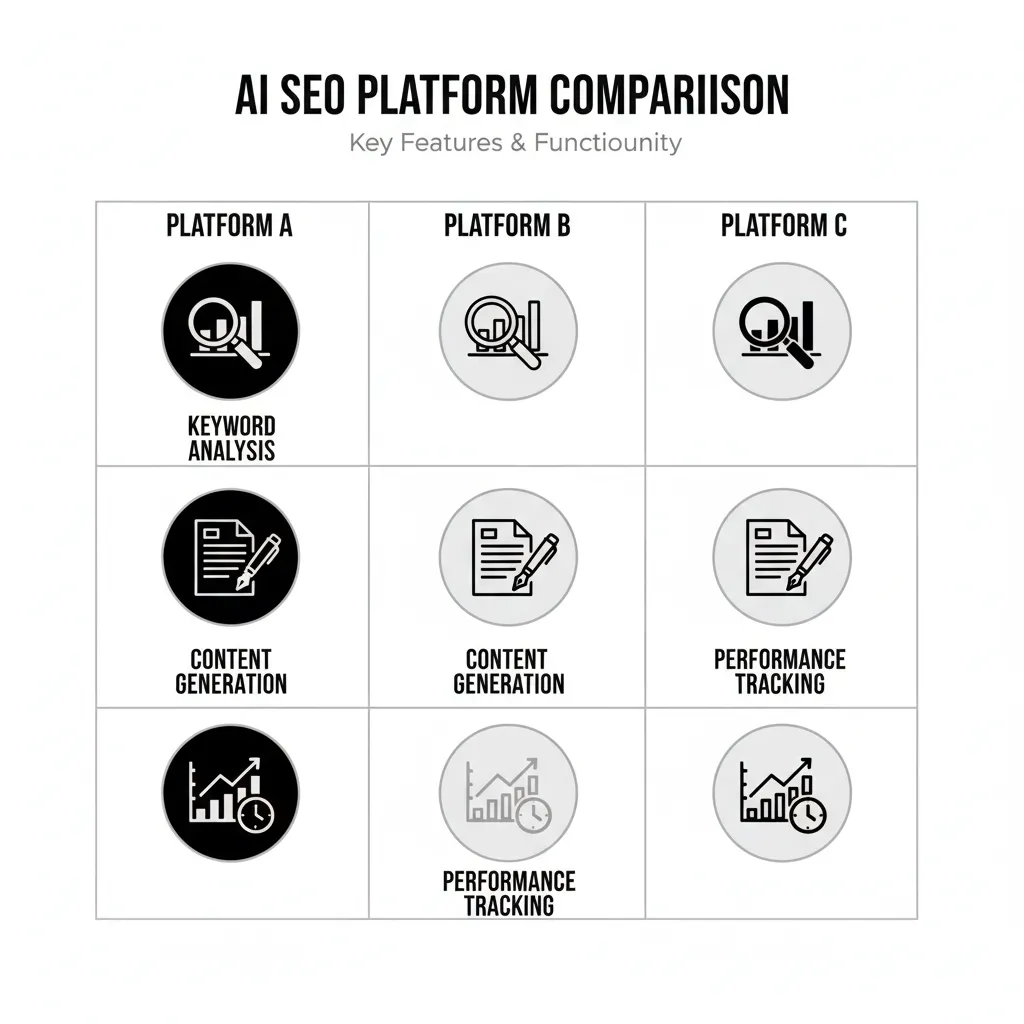
Real-time content optimization capabilities stand as the most important feature. These systems analyze your content against current search results and provide instant recommendations for improvement. They identify keyword opportunities, suggest structural changes, and optimize for featured snippets.
Automated keyword identification saves countless hours of manual research. Advanced platforms don't just suggest keywords; they understand semantic relationships and user intent. They identify long-tail opportunities and trending topics before competitors discover them.
Performance auditing functionality provides ongoing optimization insights. These systems continuously monitor your content's search performance and suggest improvements based on algorithm changes and competitor activities. This proactive approach prevents performance declines before they impact traffic.
Content brief automation streamlines the creation process from start to finish. The platform generates comprehensive briefs including target keywords, content structure, competitive analysis, and optimization guidelines. Writers receive everything needed to create high-performing content without additional research.
User-Friendly Interfaces and Integrations
The most powerful AI SEO content platform becomes useless if teams can't easily adopt it. User interface design directly impacts platform effectiveness and team productivity.
Intuitive workflows reduce training time and increase adoption rates. The best platforms guide users through complex processes with clear visual indicators and logical step progressions. Teams should be able to create optimized content without extensive technical knowledge.
Integration capabilities with existing marketing tools ensure smooth workflow continuity. Platforms should connect with content management systems, analytics tools, and project management software. This connectivity eliminates data silos and reduces manual data transfer.
Mobile accessibility enables content optimization from anywhere. Marketing teams often work across multiple locations and devices. Platforms with responsive designs and mobile apps provide flexibility for modern work environments.
3. Comparing Top AI SEO Content Platforms
The AI SEO content platform market includes several established players, each offering unique strengths and capabilities. Understanding these differences helps marketers choose the best solution for their specific requirements.

Surfer SEO focuses primarily on on-page optimization with strong SERP analysis capabilities. It excels at providing detailed content scoring and optimization recommendations based on top-ranking pages. However, it lacks comprehensive content creation features.
Clearscope specializes in content optimization through keyword density analysis and readability scoring. It provides excellent integration with Google Docs and WordPress, making it popular among content teams. The platform's strength lies in its simplicity and ease of use.
AutoRanq differentiates itself through autonomous AI systems that handle complete workflows independently. Unlike tools that require constant human input, AutoRanq's recursive exploration capabilities identify opportunities and execute strategies with minimal supervision.
Price-to-value analysis reveals significant differences across platforms. Entry-level tools start around $50 monthly but offer limited functionality. Enterprise platforms can cost several thousand dollars monthly but provide comprehensive automation and advanced analytics.
Feature Comparison Table
| Platform | Content Creation | SEO Analysis | Automation Level | Starting Price |
|---|---|---|---|---|
| AutoRanq | Full Automation | Real-time | Autonomous | Custom |
| Surfer SEO | Limited | Comprehensive | Semi-automated | $89/month |
| Clearscope | Optimization Only | Good | Manual | $170/month |
| Outranking | AI-Assisted | Advanced | High | $79/month |
Each platform serves different use cases and team structures. Smaller teams benefit from all-in-one solutions like AutoRanq, while larger organizations might prefer specialized tools for specific functions. Budget constraints and technical requirements also influence platform selection.
Integration capabilities vary significantly between platforms. Some focus on standalone functionality, while others prioritize seamless integration with existing marketing technology stacks. This consideration becomes important for teams with established workflows.
4. Case Studies: Success Stories with AI SEO Content Platforms
Real-world implementation of AI SEO content platforms demonstrates their transformative impact on digital marketing performance. These success stories provide concrete evidence of platform effectiveness across different industries and company sizes.
A B2B software company implemented an AI SEO content platform to scale their content marketing efforts. Within six months, they increased organic traffic by 300% while reducing content creation time by 70%. The platform identified untapped keyword opportunities and automated content optimization across their entire blog.
An e-commerce retailer used AI-powered content generation to create product descriptions and category pages. The automated system generated over 10,000 optimized product pages in three months, resulting in a 150% increase in organic product discovery and a 45% improvement in conversion rates.
A digital marketing agency adopted an AI SEO content platform to serve multiple clients efficiently. The automation allowed them to handle 200% more client accounts without increasing staff. Client satisfaction improved due to faster content delivery and better search performance.
A local service business leveraged AI content tools to compete with larger competitors in search results. The platform identified local SEO opportunities and generated location-specific content that improved their local search rankings by 250% within four months.
User Testimonials
Marketing professionals consistently report positive experiences with AI SEO content platforms. The most common benefits include time savings, improved content quality, and better search performance.
"Since implementing Outranking for AI SEO writing and on-page optimization, we at Clickworker have been able to increase the number of clicks on our blog by an astonishing 1000%."
— Robert Koch, SEO Manager at Clickworker
Content managers appreciate the consistency these platforms provide. Manual content creation often results in variable quality depending on writer expertise and availability. AI platforms maintain consistent optimization standards across all content.
SEO specialists value the comprehensive analysis capabilities. Platforms provide insights that would take hours to gather manually, enabling more informed optimization decisions and faster strategy adjustments.
5. Best Practices for Optimizing Content with AI Tools
Maximizing the value of an AI SEO content platform requires strategic implementation and ongoing optimization. Following established best practices ensures teams achieve the best possible results from their platform investment.
Start with clear content goals and success metrics. AI platforms work best when given specific objectives like target keywords, content types, or performance benchmarks. Vague instructions produce mediocre results regardless of platform sophistication.
Implement a structured workflow that combines AI automation with human oversight. The most successful teams use AI for data analysis, content generation, and optimization while maintaining human control over strategy, brand voice, and final content approval.
Regular platform training ensures teams stay current with new features and capabilities. AI SEO content platforms continuously evolve with new algorithms and optimization techniques. Teams that invest in ongoing education achieve better results.
Quality control processes prevent AI-generated content from being published without proper review. While AI produces high-quality content, human review ensures brand consistency, factual accuracy, and strategic alignment.
Data integration maximizes platform effectiveness by providing comprehensive performance insights. Connect your AI SEO content platform with analytics tools, search console data, and conversion tracking to enable more accurate optimization recommendations.
Monitoring Performance and Adjusting Strategies
Continuous performance monitoring enables proactive strategy adjustments that maintain competitive advantages. AI platforms provide real-time data, but teams must interpret this information and take appropriate action.
Establish regular review cycles to assess content performance and identify optimization opportunities. Weekly reviews work well for active content programs, while monthly reviews suffice for smaller operations.
Track key performance indicators beyond just search rankings. Monitor organic traffic, engagement metrics, conversion rates, and business impact to understand the complete value of your AI SEO content platform investment.
Adjust content strategies based on performance data and algorithm changes. AI platforms detect these changes quickly, but human interpretation ensures strategic responses align with business objectives.
Advanced AI SEO Content Platform Capabilities
Modern AI SEO content platforms extend far beyond basic content generation and optimization. Advanced capabilities include predictive analytics, competitive intelligence, and automated strategy development that provide significant competitive advantages.
Predictive content analytics help teams identify trending topics before they become competitive. These systems analyze search patterns, social media trends, and industry developments to predict content opportunities weeks or months in advance.
Automated competitive analysis provides ongoing intelligence about competitor content strategies. Platforms monitor competitor publications, analyze their optimization techniques, and identify gaps in their content coverage that represent opportunities.
Multi-language content optimization enables global content strategies without proportional increases in resources. AI platforms can optimize content for different languages and regional search preferences simultaneously.
Technical SEO automation addresses on-page optimization factors that manual processes often miss. These systems optimize page load speeds, meta tags, schema markup, and internal linking structures automatically.
Integration Strategies for Maximum Impact
Successful AI SEO content platform implementation requires thoughtful integration with existing marketing technology and workflows. Strategic integration amplifies platform benefits while minimizing disruption to established processes.
Content management system integration streamlines the publishing workflow from creation to publication. Direct integration eliminates manual content transfer and reduces the risk of optimization errors during publishing.
Customer relationship management integration enables personalized content strategies based on customer data and behavior patterns. This connection allows AI platforms to optimize content for specific audience segments and buyer journey stages.
Social media platform integration extends content optimization beyond search engines to include social discovery and engagement. AI systems can optimize content for both search algorithms and social media algorithms simultaneously.
Analytics platform integration provides comprehensive performance measurement across all marketing channels. This holistic view enables better attribution modeling and more accurate ROI calculations for content marketing investments.
Future Trends in AI SEO Content Platforms
The AI SEO content platform industry continues evolving rapidly with new capabilities and technologies emerging regularly. Understanding these trends helps marketers prepare for future opportunities and challenges.
Voice search optimization becomes increasingly important as smart speakers and voice assistants gain adoption. AI platforms are developing capabilities to optimize content for conversational queries and featured snippet formats that voice assistants prefer.
Visual content optimization represents a growing opportunity as image and video search become more sophisticated. AI platforms are beginning to include image optimization, alt text generation, and video content analysis in their feature sets.
Personalization at scale enables individual content optimization for different user segments without manual intervention. Advanced AI systems will soon optimize content dynamically based on user behavior, location, device, and search history.
Cross-platform content optimization ensures consistent messaging and optimization across all digital touchpoints. Future platforms will optimize content simultaneously for search engines, social media, email marketing, and other digital channels.
Measuring ROI from AI SEO Content Platforms
Demonstrating return on investment from AI SEO content platform implementation requires comprehensive measurement strategies that capture both direct and indirect benefits.
Direct traffic improvements provide the most obvious ROI indicators. Track organic traffic increases, search ranking improvements, and click-through rate enhancements directly attributable to AI-optimized content.
Productivity gains represent significant but often overlooked value. Calculate time savings from automated content creation, optimization, and analysis processes. Multiply these savings by team hourly rates to determine productivity ROI.
Quality improvements impact long-term performance through better user engagement and search algorithm preference. Monitor bounce rates, time on page, and conversion rates to measure content quality improvements.
Competitive advantages provide strategic value that compounds over time. Track market share growth, keyword ranking improvements versus competitors, and content gap closure to measure strategic benefits.
Cost reduction analysis compares platform costs against traditional content creation expenses. Include reduced freelance costs, decreased tool subscriptions, and lower training requirements in ROI calculations.
Common Implementation Challenges and Solutions
Organizations implementing AI SEO content platforms often encounter predictable challenges that can be addressed through proper planning and change management strategies.
Team resistance to AI automation stems from concerns about job security and technology complexity. Address these concerns through comprehensive training, clear role redefinition, and demonstration of how AI enhances rather than replaces human capabilities.
Integration complexity can overwhelm teams without technical expertise. Choose platforms with strong support teams and comprehensive documentation. Consider hiring implementation consultants for complex enterprise deployments.
Content quality concerns arise when teams worry about AI-generated content meeting brand standards. Implement robust review processes and customize AI training data to match brand voice and quality requirements.
Budget justification challenges occur when leadership doesn't understand AI platform value. Develop comprehensive ROI projections including productivity gains, quality improvements, and competitive advantages to support investment decisions.
Performance measurement difficulties arise when teams lack clear success metrics. Establish baseline measurements before implementation and define specific KPIs that align with business objectives.
In the rapidly evolving digital marketing environment, AI SEO content platforms have become indispensable tools for ambitious marketers seeking to scale their content production while maintaining quality and relevance. These platforms transform traditional content workflows through automation, intelligence, and strategic optimization that delivers measurable results.
The most effective AI SEO content platforms combine multiple capabilities into unified systems that handle everything from keyword research to content optimization. AutoRanq exemplifies this approach through autonomous AI systems that think, plan, and execute complex workflows independently, allowing marketing teams to focus on strategy rather than tactical execution.
Success with these platforms requires strategic implementation, ongoing optimization, and commitment to best practices. Teams that embrace AI-powered content creation while maintaining human oversight achieve the best results through improved efficiency, better search performance, and scalable content production.
Key takeaways for implementing an AI SEO content platform include:
- Choose platforms with comprehensive automation capabilities that match your specific workflow requirements
- Implement structured processes that combine AI efficiency with human strategic oversight
- Monitor performance continuously and adjust strategies based on data-driven insights
- Invest in team training to maximize platform capabilities and ensure successful adoption
- Measure ROI through multiple metrics including traffic, productivity, and competitive advantages
The future of content marketing belongs to organizations that successfully integrate AI SEO content platforms into their strategic operations. These tools provide the speed, scale, and intelligence needed to compete effectively in modern search environments while delivering the consistent, high-quality content that audiences and search engines demand.
Ready to transform your SEO content strategy with autonomous AI technology? Explore how AutoRanq can revolutionize your content production workflow and accelerate your digital marketing success through intelligent automation and strategic optimization.